How to Read Composition in One Artwork in Five Minutes
Use a five-minute look at one artwork to trace its visual structure, notice what the arrangement emphasises and leave with a precise observation.
The common mistake in looking at a painting or sculpture is to name its subject before noticing how its parts are arranged. A five-minute look at one artwork gives you time to trace that structure: see the whole, follow a visual route, then check how a detail changes the arrangement you first perceived.
Spend the five minutes on composition, not plot
Use a simple time plan: spend the first minute taking in the whole, the next two tracing a route across the work, and the final two checking its edges and one detail. If a gallery visit is busy, keep the sequence in your head rather than using a phone timer.
Stand where you can see the work without craning or blocking anyone else. Notice whether its forms are clustered or spread out, whether its main directions feel steady or active, and where the largest areas sit in relation to the edges.
For a sculpture, start with the silhouette from the permitted viewing position. Notice which parts project, which spaces are enclosed, and whether one form hides another; do not cross barriers or touch the work.
Composition is the organisation of shapes, spaces and directions, not simply a synonym for balance. For now, describe the arrangement in plain terms before deciding what it might imply.
Trace a route through the arrangement
Choose one clear starting point: a face, a large shape, a diagonal, a strong edge or a point where forms meet. Follow where your eye goes next, then name the visible connection that carries it onwards.
A line need not be drawn in the work. A row of repeated marks, an arm’s direction or the contrast between a crowded area and an open one can create a route. Record the sequence concretely, such as “from the figure’s shoulder to the doorway”, rather than settling for “the composition is balanced”.
Notice where the route slows, stops or turns. A gap, overlap, abrupt edge or isolated shape can interrupt the flow and give one part more weight than its size suggests.
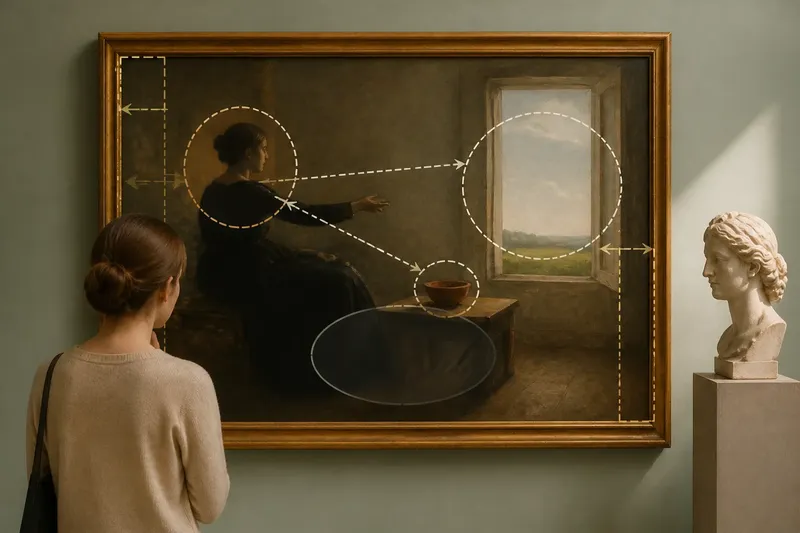
Imagine a painting with a dark figure near the left edge, a pale window on the right and a small bright bowl between them. You first follow the figure’s outstretched arm towards the window, then the bowl catches your eye; the resulting observation is that the arrangement sends attention across the canvas before pulling it back to the centre.
Read the edges, gaps and overlaps
Composition becomes clearer when you compare the centre with the margins. Ask whether the main forms sit securely inside the frame, press against an edge, or seem cut off by it; each choice changes how the visible space is organised.
Look at the gaps between forms as carefully as the forms themselves. A narrow gap can make two figures seem close, while a broad open area can separate a group or give a single object room to stand apart.
Check overlaps and occlusions: which shape appears in front, which is partly hidden, and where does the order become uncertain? These observations describe the work’s structure without requiring a claim about the artist’s intention.
Make one note about what the arrangement makes prominent and another about what it pushes towards the edge, hides or leaves open. Both can be specific: “the clustered figures dominate the centre” and “the doorway is partly cut off”.
Check the composition prompts against what you see
- Whole: Check whether forms are clustered or dispersed; if they cluster, note where the visual weight gathers, then compare that area with the open space.
- Starting point: Check which feature catches your attention first; if it is a strong edge or large shape, trace the next visible connection, otherwise begin with the clearest form.
- Route: Check whether a line, gesture or repeated mark carries your eye onward; if it does, name its destination, otherwise record where your eye stops.
- Pause: Check for a gap, overlap or abrupt edge that interrupts your route; if one interrupts it, note the shift in direction, otherwise follow the route to its endpoint.
- Margins: Check whether forms touch or cross the frame’s edges; if they do, consider how that crops or extends the arrangement, otherwise compare the margin with the centre.
- Depth: Check which forms overlap and which spaces appear open; if the order is clear, describe what sits in front, otherwise note where the depth remains ambiguous.
Use these prompts as decisions about where to look next, not as boxes to tick. If a prompt offers no visible evidence, move on to the next part of the arrangement.
Answer common questions about composition?
What should I look at first in an artwork?
Start with the whole arrangement and notice its largest shapes, main directions and open spaces. This gives you a structural view before the subject draws you into a story.
How can I tell where a composition directs my eye?
Pick a starting feature and follow the next connection you can see, such as a diagonal, repeated shape or gesture. If your attention jumps rather than travels smoothly, note the jump as part of the arrangement.
What do the edges of a composition tell me?
Edges show whether forms are contained, cropped or pressed against the frame. Compare them with the centre to see how the work distributes visual weight and space.
What if I cannot decide what the artwork means?
You can describe its composition without deciding on a single meaning. State where attention gathers, what interrupts its route and how the spaces relate, then leave interpretation open.
Finish with a composition-based observation
Use your final minute to return to the whole and put one structural observation into a sentence: “The repeated narrow forms lead towards the empty corner, leaving the crowded centre unsettled.” This five-minute look at one artwork works best when the sentence names an arrangement you can point to, rather than a story you cannot verify from the composition alone.
If you have time before moving on, check whether your sentence accounts for both the route and the space around it. That last comparison often shows whether the work’s pull comes from a dominant form, an interruption or the relationship between them.